Showing posts with label occupational therapy. Show all posts

Saturday, 11 January 2014

Introduction to the NOTCE

DISCLAIMER:  ALL IMAGES IN THIS BLOG POST ARE IN ENTIRETY OWNED BY THEIR RESPECTIVE ORGANIZATIONS. SOURCES ARE PROPERLY LISTED AT THE END OF THE POST.  NO ILLEGAL IMAGES ARE SHARED. THEY ARE CROPPED FROM DOCUMENTS FREELY SHARED BY THE ORGANIZATIONS. 


What is it?

The National Occupational Therapy Certification Exam (NOTCE), formerly known as the Canadian Association of Occupational Therapists (CAOT) Exam, is the nationwide written test of OT knowledge of theory and applications here in Canada.  Its prime purpose is to protect the public by assessing individuals who wish to practice occupational therapy (OT) all over the country.  Second, since OT is a regulated health profession, all regulatory organizations require the NOTCE for full registration.  It is held twice a year on the first Saturdays of July and November.  Exam sites are available nationwide.  You can choose which province you want to take the exam early in registration, although the specific location is not given until a few weeks before the exam date.  As you go on reading this, we will delve on the resources you need to read, question formats and scoring method of the NOTCE.  Essential web reads and stuff to browse and download are linked in the text.  


The Blueprint, Profile and Essentials

In order for you to be successful in any exam, there are many things to know aside from the content of the exam.  To be fully ready, one must know how the exam is written.  You might remember from highschool or college days how teachers and professors have different formulations of their quizzes.  Who gives out keywords?  Who doesn't?  Who likes essays and tables?  Who likes identification or multiple choice type of questions?  Some of those may seem minuscule to the content of the exam but it might surprise you to know that how you organize the content of your review to a certain design may score you more points than just merely memorizing the books from page 1 to the glossary page.

To start off knowing the NOTCE, let me tell you, there is nothing quite like the Resource Manual to let you have a peak at your Lady Victory.  It has it all!  The purpose of the exam, question formats, reference source and even sample exam questions.  It's like our lovable Spacky - everything essential condensed in one.  Now, the most important thing to take note of in this manual is the BLUEPRINT.  The blueprint is a graphic representation of the exam components and its framework.  In a simpler angle, I'd like to think of it as a flower in a plant box.

The Blueprint1

It displays the dynamics of OT knowledge of the client, environment, occupation, practice process and the OT roles which we as therapists assume in the profession.  The big center where the seeds are located compose of the examinee's knowledge of the CEO and OT process.  This stands for sixty to seventy percent (60-70%) of the exam and can be found tabulated in more detail in figure 2.

The Matrix2

The colorful petals represent the six (6) major roles we assume in professional practice. These overlap at the center to show the dynamic unfolding of the roles centralized on the knowledge we know to enable our clients through the occupations they deem meaningful in their lives.  This comprises of the thirty to forty percent (30-40%) of the exam.  Lastly, the plant box nurtures the flower of knowledge and roles by supporting the practice with theories that we apply in clinics; vice versa, the applications evolve the theories we use through research.

Upon introduction to the blueprint, I'm sure more questions will surface in your mind - most especially, on the definition of each role in professional practice.  This is where we turn to the Profile of Occupational Therapists in Canada (a.k.a. the Profile) and the Essential Competencies of Practice for Occupational Therapists in Canada (a.k.a. the Essentials).  The PROFILE provides the big picture of Canada's vision for its occupational therapists and is updated/revised every so often by the council.

Canada's vision for every OT - from competent to proficient and eventually to advanced practice3


The Profile briefly defines the competencies that OTs need to achieve in practice.  These are the OT roles I have enlisted below: (1) expert in enabling occupation; (2) communicator; (3) collaborator; (4) practice manager; (5) change agent; (6) scholarly practitioner and (7) professional.

Figure in the Profile similar to the exam blueprint 4

There is a table after the image that delineates each component.  Though this is just a very general description of each role.  To further explain these competencies, we will need to turn to the ESSENTIALS.  You'll be able to understand more about the profile more and what are the criteria that deem all practitioners "competent".  To put it simply, the essentials is the detailed qualities that make a "competent" OT.


Resources and Reads

So now that you are familiar with the manual, profile and essentials, we will be discovering important resources for your review.  Although you might be with lots of OT resources, there are other references you might not be aware of just like the Profile and Essentials.  The first place you look into for identifying potential review materials would be the Resource Manual.  They are magnificently chronicled at the back of the manual.

The start of the reference list, perfectly written in APA format5


I marked all of the books I have then I browsed on the web to have information on the others.   I checked the local library if they had any occupational therapy books.  Sadly, they don't have much OT books there.  I heard from a friend thought that I can access the University of British Columbia Library where they have a large collection of allied health professional books.  If you can, borrow books to save money.

Here I list the resources that I have referenced from in my review:

1. Enabling Occupation I and II - both books are definitely a necessity to read.  You can buy it in the CAOT store or borrow it from a library that has it.  Important to note the CPPF and the OPPM.
2. Trial Occupational Therapy Exam Manual (TOTEM) and the Trial Occupational Therapy Exam (TOTE) - contains exam questions you can practice on.  Check out CAOT website for more details.
3. Occupational Therapy for Physical Dysfunction (Pedretti or Trombly) - covering for the physical dysfunction knowledge.
4. Willard and Spackman's Occupational Therapy - need I say more?  It's your Yorozuya and it has it all.
5. Quick References to Occupational Therapy - good for when you need to quickly refer to conditions
6. Conditions in Occupational Therapy - much like the "Quick References" book, this is also a nice book in which they condensed all of the conditions.
7. Group Dynamics in Occupational Therapy - best resource for knowledge on groups, from theory to application.
8. Psychosocial Occupational Therapy: Frames of Reference for Intervention - greatest reference on theory in psychosocial practice.
9. Kaplan and Sadock's Symptoms of Psychiatry - where all the psychological conditions can be found.  The resource manual has listed the DSM-IV-TR but I find this easier to remember.
10. Occupational Therapy for Children - the pediatrics Bible.
11. Ethical and Legal Dilemmas in Occupational Therapy - this book is magnificent for knowing ethical practice with case scenarios.
12.  Introduction to Splinting - the foundation for splinting.   The review questions every chapter is great for igniting your clinical reasoning skills concerning with this OT task.  Case studies available as well.
13. Cook and Hussey's Assistive Technologies - essentials on the types of assistive devices, assessment procedures. Another thing that is wonderful about this book is that it has a list of organizations in which these devices are available. I'm pretty sure that there was another book on assistive devices but I wasn't able to borrow it from the library.  Everytime I went there, it's always borrowed.
14. Measuring Occupational Performance - worried about your knowledge on assessments and performance measures?  This is the ultimate book!  It classifies them into categories and tabulates its information.  This is a definite must-read for review.
15.  Guidelines on Controlled Acts and Delegation - list of controlled acts in the profession.
16.  Regulated Health Professions Act - it is most important to know certain legislation that concerns the practice.
17.  Canadian Health Act - yet another legislation we must be aware of.
18.  Health Professions Act - another legislation on the health care world.  Pretty long but knowing it early on will help you in practice in the future.  Especially when it comes to claiming your rights as a professional and to have an idea on how the regulatory body works.
19.  Accessible Housing by Design (ramps) - a question on accessibility might come out and knowing about the design acceptable is sufficient.
20. Occupational Therapy Assessment Tools:An Annotated Index - again, another magnificent book on instruments used in practice.
21. Functional Performance in Older Adults - knowledge on geriatrics practice.
22. Conceptual Foundations of Occupational Therapy Practice - a great book that summates the most widely used body of theories in practice.
23. Research in Occupational Therapy - best book to read about research in our field.  In fact, it is very easily understood that you needn't look elsewhere.  I'm pretty sure I browsed another book about research but I totally forgot that other one.


Additional resources:
1. Occupational Therapy examination and practice preparation project for IEOTS (aka OTepp project)


A wonderful organization which helps you understand the health care system here in Canada.  It is also, as I have described in my previous post, a virtual agora in which occupational therapists worldwide gathers and shares their knowledge.  I learned a lot from the OTepp program and I have to say, I never would have imagined starting from elsewhere.  Check out their website and see for yourself how magnificent the program is.

2. CAOT's Occupational Therapy Exam Module (aka OTEM) 


This used to be offered by OTepp but it was carried over to CAOT.  It is an online discussion group which assists examinees in preparing for the exam.  It has over 100+ questions in reserve to discuss with in order to mold the quick rationalizing during the actual exam.  

3. Orientation to the Canadian Health Care System, Culture and Context 

They offer online courses for internationally educated health professionals (IEHPs) on the Canadian Health Care system.  

For your basic sciences and medical-surgical review, I suggest that you stick to resources you feel comfortable with.  After all, there can be lots I can suggest but it will be up to you and on how your reinforcement system works.  I decided to stick wiht my old books Seeley, Snell, Guyton and Gilroy for I've used them quite a lot since college; thus, retrieval of information may be easier due to the repetitive factor.


Questions and Format

The way the examiner formulate the questions are quite unique.  They present a case to you in such a way that you might be in front of the actual client.  From there, they derive 2 to 5 questions.  I suggest from here, you must have at least read the resource manual.  If not, please do.  It will be less confusing.

Now, here is the number 1 case and question example on the resource manual6:

Client: Mrs. C is a 66 year old woman. 

Situation: 
• She is recently divorced. 
• She lives alone in a seniors’ apartment 
• She has decreased functioning as a result of a degenerative neurological disorder 
• She was getting home-making services in her apartment 
• She was going to a geriatric day hospital to receive treatment related to physical problems 
• Her physical problems include unstable gait, decreased balance, potential risks for falls, 
decreased vision and general safety 
• She has been admitted to an in-patient geriatric unit due to increasing depression 
• On admission to the in-patient geriatric unit, she is withdrawn, irritable, expressed vague 
suicidal ideation, and has stopped doing previous leisure activities 
• Her previous leisure activities included music and sewing 
• She has few close friends who are of the same age nearby 
• She has one daughter who lives several hundred kilometers away 

ITEM 1 
What should the occupational therapist do FIRST to address Mrs. C’s depression? 

1. Arrange a visit from her friends. 
2. Challenge her with new activities. 
3. Engage her in short term, familiar activities. 
4. Suggest she attend the unit’s Friday evening social event. 


ITEM 2 
Mrs. C. tells the occupational therapist that she is upset that her decreased vision means that she is no 
longer able to sew. Using a client-centred perspective, what should the therapist do FIRST? 

1. Suggest other leisure activities using the Interest Check List 
2. Explore low vision aids and techniques that could allow Mrs. C. to sew 
3. Encourage Mrs. C. to join activities at her local Senior’s Center 
4. Assist Mrs. C. to find a volunteer to help her do her leisure activities 


ITEM 3 
At discharge, the occupational therapist will recommend that Mrs. C. attend an activity at her local 
Seniors’ Centre. Which activity would be MOST appropriate for the therapist to suggest? 

1. Music enjoyment group. 
2. Recreational dancing. 
3. Playing cards. 
4. Recreational swimming. 

ITEM 4 
Mrs. C. is often impulsive and is not following safety guidelines when walking with her walker. What 
should the occupational therapist do? 

1. Set up a behaviour modification program for Mrs. C. 
2. Continue teaching walker use, providing only 1 to 2 step instructions. 
3. Further assess Mrs. C’s comprehension and ability to remember information. 
4. Encourage Mrs. C. to regain internal locus of control and take responsibility for her safety. 

ITEM 5 
The multidisciplinary term is not confident that Mrs. C. has the functional ability needed to return to 
her apartment. Mrs. C. strongly states that she wishes to return to her apartment. What should the  occupational therapist do? 

1. Have a discussion with Mrs. C. about safety and her ability to manage at home. 
2. Arrange for increased home care services. 
3. Investigate the potential for repeated hospitalizations. 
4. Provide legal documentation of Mrs. C.’s incompetence. 

For rationale, you can refer to the resource manual.  If you change information on the following case such as this:

-Mrs. C's leisure activities include watching television and walking.
-Mrs. C has macular degeneration.

NOTE:  This change in the sample number 1 of the resource manual is by NO MEANS AN OFFICIAL ONE.  It is just formulated by me in a mere example of knowing the client and their occupation. Also, the answer and rationale I have provided is again not in the official document.

If a question surfaces on which activity would be MOST difficult for her? Which would you choose? Think first before you read ahead.
1.watching television 
2. walking outside around their house
3. dogsitting 
4. playing UNO

It might surprise you that it would be number 1 because in this activity central vision is vital.  Since Mrs. C has macular degeneration thus we know that central vision is compromised.  The other activities can be done with intact peripheral vision.  See how each case can vary differently with just those alterations? It test how well you know the client in their environment and how it affects the occupations they deem meaningful in their lives. My best advice is to see it upon yourself that you view each case as if you are facing a client.  When you move on to the next question, it means that you get to meet another client who may have similarities but they are most definitely not one in the same. 


Items and Scoring

The exam for my batch was composed of two hundred (200) questions.  I assume that it was two points if you get the answer correct and zero if you pick the wrong choice.  That means overall, the exam would be a total of four hundred and in order to pass you need 70% - that is 290.  Funny though, if you calculate the 70% from the 400 it would be 280.  They added 2.5% to make it 72.5% so yeah, it's 290 points according to the PROCEDURES MANUAL.   Also some exceptions are made for certain questions.  You see, every batch of exams, a different set of questions are pulled from a "bank" and some are "experimental".  If the experimental questions are drawn from the bank, and a lot of the examinees have varied answers rather than the expected one, the question gets reviewed and possibly thrown out of the count.   That is probably why the waiting time for your exam results is a span of 6 to 8 weeks.  A council still reviews it.  

Although in the procedures manual, they indicate that they just put on the range of 290 - 450  (I'm not sure either why it's up until 450 instead of 400) if you passed, my results came in a very detailed breakdown of the components patterned to the blueprint.  I noted that they have revised it in 2010 as indicated in the copyright page.  Maybe they have yet to change it in the manual.

Of course this amateur collation of information is useful for those who are already registered to take the examination.  Please do refer to my previous post - The Unofficial Guide to CAOT Application for IEOTs for the procedures on applying for the NOTCE.  And do check the CAOT website for updates of the resource manual and other official documents.


Footnotes:
1Canadian Association of Occupational Therapists. (2006). National Occupational Therapy Certification Exam (NOTCE)        Resource Manual. Ottawa, ON: CAOT Publication ACE. Retrieved from the website on January 11, 2014:  http://www.caot.ca/pdfs/Exam/ExamResMan10.pdf
2Canadian Association of Occupational Therapists. (2006). National Occupational Therapy Certification Exam (NOTCE)        Resource Manual. Ottawa, ON: CAOT Publication ACE. Retrieved from the website on January 11, 2014:  http://www.caot.ca/pdfs/Exam/ExamResMan10.pdf
3Canadian Association of Occupational Therapists. (2012). Profile of Occupational Therapy Practice in Canada. Retrieved from the website on January 11, 2014: http://www.caot.ca/pdfs/2012otprofile.pdf
4Canadian Association of Occupational Therapists. (2012). Profile of Occupational Therapy Practice in Canada. Retrieved from the website on January 11, 2014: http://www.caot.ca/pdfs/2012otprofile.pdf
5Canadian Association of Occupational Therapists. (2006). National Occupational Therapy Certification Exam (NOTCE)        Resource Manual. Ottawa, ON: CAOT Publication ACE. Retrieved from the website on January 11, 2014:  http://www.caot.ca/pdfs/Exam/ExamResMan10.pdf
6Canadian Association of Occupational Therapists. (2006). National Occupational Therapy Certification Exam (NOTCE)        Resource Manual. Ottawa, ON: CAOT Publication ACE. Retrieved from the website on January 11, 2014:  http://www.caot.ca/pdfs/Exam/ExamResMan10.pdf


Sunday, 10 November 2013

Seven Ways To Motivate Yourself

As part of the rehabilitation team, we occupational therapists use our disposition to be therapeutic.  In the purest sense, we must be motivated to move others.  For how can a full-fledged bonfire start without the tiny sparks?  But, of course... we are human as well; and oftentimes in our adult lives, we face daunting situations that leave us feeling dejected.  Even for some, the everyday "normal" lives make us feel dull and jaded - that we are stagnant of some sort.  This slump can go on for as long as you allow it to.  And yes, when you're in that pit of boredom and frustration, you might start to think that that is where you ought to be - decrepit and useless.  As Dr. Seuss said, "Un-slumping yourself is not easily done."

Here I share with you the things I usually do when I'm in a slump.

1. Take a walk 
I've found that when you wake up in the morning and you feel that certain uncomfortable nudge of the slump, it will set out to keep you at home.  If it starts to whisper, then the best thing to do is to GO OUT. Take a walk!  By taking a slow walk outside, you'll be able to give yourself time to reflect. You'll notice small things that you've never concerned yourself with before.  Minuscule circumstances like a child walking with their parents, an old lady waiting for the bus, teenagers walking with their friends on the pavement and cars bustling by as you take your walk.  Random acts of kindness like a man opening a door for the next person or walking by the dangerous side of the pavement to shield a stranger.  And in that simple walk you took, you'll be filled with obscurity of wonders - how people in your small community live their best in small ways.  That your existence may be small but significant and surely, as you traveled from your house to whichever direction you went, you're unmotivated self too shall pass.  

2. Read something inspirational 
I always believe that words have spirit. That whatever kind of words you speak can hold a person captive or unbind them if you will.  It goes the same for whatever you feed your mind.  Words that you read can inspire you into motion or keep you prisoner in your current mindset.  True to my belief, I have survived the adjustment phase in Canada by living on my everyday "inspirational something".  Be it a quote from a scientist of the past century, a contemporary poem or a Dr. Seuss book, I read them and let them linger in my mind.  It's even funny to admit that I look forward to reading Vancouver 24 Hours's horoscope because I find them inspiring.  The way in which they construct their sentences are always so positive and encouraging. I also have this application with lots of motivational quotes that randomizes quotes everyday. I start my day empowered by such words and still do.

Here is a list of quick motivational reads and links to quote sites I frequent:
1. Don't Quit Poem - a very famous poem since I was a child.  Whoever wrote it, kudos to you.
2. If - by Rudyard Kipling - this is a great poem to make you start reflecting on yourself.
3. Mutability by Percy Bysshe Shelley  - a poem that will make you realize the world is never stagnant.
4. On Quitting by Edgar Guest - a poem telling on how hard it is to let go of something you truly love.
5. Brainy Quotes - frequent site I visit for quotes.  They have an archive of quotes in landscape backgrounds.
6.  Think Exist - frequent site I visit again for quotes.  No pictures however.
7. I Like To Quote - an imageboard for quotes that is easy to share with social media.
8. Incidental Comics - I recently discovered the genius of Grant Snider.  He has some really great stuff in his site about a variety of topics.  Well, mostly art but still his works are quite inspiring.


3. Listen to music
Much like how words move you, add melody to that and you have magic.  I grew up in a house filled with song and I've realized how music can generally empathize with you to heal your soul.  To me, listening to music is like breathing, like going back to the basics of life.  There's nothing like a song that can express your remorse and unmotivated self then another different song to cheer you up out of that slump.  Listening to music always has that connection to one's soul.  It hooks deep and fishes out those bad feelings and can patch it up nicely with warm, positive ones.  

Here is a list of some moving songs I like and recommend (may contain Japanese songs):
1.  Closer To The Edge by 30 Seconds to Mars - a song about determination in life and looking past your regrets.
2.  What Doesn't Kill You (Makes You Stronger) by Kelly Clarkson - definitely one of those songs to pump up your day with self confidence
3.  Firework by Katy Perry - an uplifting song on inner beauty and potential.
4.  Unwritten by Natasha Bedingfield - I heard this song first from a shampoo commercial and got hooked!  It's about taking the future into your hands.
5. What A Wonderful World by Louis Armstrong - quite an old song that will make you reflect on the bigger picture of everything. You'll be thankful for the small things that make up your life.
6. It's My Life by Bon Jovi - it's a lovely rock song about following your will and pursuing life with unrelented passion.
7. Have A Nice Day by Bon Jovi - another Bon Jovi song that string up the daily dose of courage you need.
8. Defying Gravity (from Wicked) by Idina Menzel and Kristin Chenoweth - from a broadway musicale about fighting for what you believe in.  There is  a Glee version but I prefer this better.
9. One Step At A Time by Jordin Sparks - a song about reaching your goal by taking one small step after another.
10. Skyscraper by Demi Lovato - Demi's comeback song rising up after failing many times
11. Who You Are by Jessie J - a very powerful song speaking of loving yourself as you are.
12. The Climb by Miley Cyrus - Disney Miley's song on facing obstacles in life.  
13. Try by Pink - a new song by Pink about taking chances in love.
14. When You Believe by Whitney Houston and Mariah Carey - a classic song by two unbeatable divas of our time regarding having faith.
15. Bad Day by Daniel Powter - probably the most famous song in the list if I might say so. The most empathetic song in the list too. Who would've thought it was released a decade ago?  
16. Complain by David Archuleta - a song from Archie's 2nd album which moves you to action.  
17.  That's The Way It Is by Celine Dion - a love song released almost 15 years ago that never fails to uplift my mood.  It's about not giving up and working hard in your relationship.
18.  Chances Are by Five for Fighting - actually a love song but speaks of taking chances on life.
19.  Warattetainda by Ikimonogakari  LYRICS TRANSLATION - a song that describes strongly moving into an optimistic future .
20. Dareka ga by Puffy AmiYumi  LYRICS TRANSLATION - a popular song from the anime Naruto that speaks of supporting each other in fretful times.
21. Muteki no Kimi by Fukuyama Masaharu  LYRICS TRANSLATION - a song by my favorite J-artist about independent women and their courageous souls.
22. Against Wind by Akutagawa Jirou - a song from the anime Prince of Tennis about adversity and how you could overcome it.
23. Brave by Sara Bareilles - a fairly new song about standing up for yourself.  The video is quite interesting as well like here "Uncharted" one.
24.  Makenaide by ZARD  LYRICS TRANSLATION - an old Japanese song from the 90s about not giving up.
25. Uncharted by Sara Bareilles - I love this song!  It speaks of moving forward from where you are now to your goal.  

4. Do something productive
Unbeknownst to many, accomplishing a little task everyday could greatly improve your disposition.  Setting a small goal such as arranging your clothes in the closet or trimming your house plants and finishing it can help you feel fulfilled throughout the day.  Take a moment to think about the time when you are in an upsetting mood, then you engaged yourself into something that produced results. There is a certain satisfaction in that. The feeling is small but its effect in your soul resounds through your body - like a raindrop creating a ripple in a larger body of water.  Start by doing small things a day then proceed to bigger tasks to complete.

5. Keep a hobby
There is nothing comparable to immersing yourself in things in which you can express yourself freely. In the midst of the almost maddening effects of the slump, you'll find that engaging in your hobbies will keep you sane.  It is entirely different from other activities which we "put effort" in most of the time, as the motive to do them comes intrinsically.  The motivation to do them comes out naturally as though the hobby was already part of you even before you were born.  Thus, we rather than expending energy and getting tired, we become emotionally charged when we do our hobbies.  If you don't happen to have one or feel like you need a hobby change, then try looking at the community board and find something that may pique your interest.  

6. Self-reflect and move on
I confess to my abysmal habit of reflection.  Most especially towards myself.  I have always been delving in thoughts of queries and answers.  At times when I feel unmotivated, I try to look inside myself to find the reason as to why I am in such state.  Why do I feel down?  What events lead to me feeling suddenly unmotivated?  What did I do to remedy those?  If there weren't anything I can do about those things, then what am I supposed to do?  Those kinds of questions come up and somehow, through the long process of rationalizing with yourself, you'll be able to know just where you stand right now in life.  And from there, you'll pick up on your trail.

A beautiful art about self-reflection found in Incidental Comics!


7. Pray
I find that at times when everything just falls into chaos and that no matter what I do, I can't seem to relieve my restlessness, I pray.  When you've tried all of the things that can possibly cure your seasonal slump and still it won't go away, perhaps it's time to surrender your mind to a Higher Power.  You'll find the peace you need.


That's it for my 7 ways to motivating yourself. These are the things that work for an introvert like me.   I suggest browsing through the song list!  They are absolutely wonderful. And feel free to suggest things that work for you when you're unmotivated on the comment box!   I might try it out and see if it will fit for me too.  (*^_^*)

Here is a little advice I got from Aboriginal Day (@^ - ^@)


Saturday, 17 August 2013

OTepp's Final Bow


For several years now, the Occupational Therapy examination and practice preparation (OTepp) project has assisted a multitude of internationally educated occupational therapists (IEOTs) seeking to enter the healthcare system in Canada.  OTepp has guided IEOTs to achieve the level of competency needed to enter occupational therapy practice here.  In fact, the program serves not only as a government funded program intended to develop IEOTs to the populace's liking but it also serves as a modern-day agora where OTs from all around the world can gather and illuminate each others' mind with cultural diversity.  Sadly, this wonderful program is in its last year.  

A farewell party was held at the Sheraton Vancouver Wall Centre Hotel in Burrard last July 16.  Most of the current students and even some former ones along with the McMaster University staff were present. It was nice to see and actually meet the people behind the voices during the online classes - Shami, Sue, Colleen and even Nancy to whom I was in contact with since I was an intern. (sorry if I missed some names) And even though I was only able to enroll for the 3rd and 4th module - which is the using evidence in practice and the clinical reasoning respectively - I was welcomed with much warmth.  

Here are some of the pictures from the party:  (courtesy of Miss Pinky Valerio)
Printed invitation for the farewell party
Sue Baptiste giving the opening speech
Group picture number 1!
Group picture number 2!

OTepp has made me realize a lot of things about the passion I pursue - that is occupational therapy.  Primarily, I realized that there is a huge difference of OT practice here and my home country, the Philippines.  Here in Canada, where the local communities play a big part in the overall country's development, an OT needs to know of the resources he/she can access in the community.  If you know your community well, you can better integrate the client into that community.  Like for example, what is the difference of a residential home versus an assisted living home?  And how would you utilize that resource in practice?  Subsequently, an OT does not only present literature as evidence of the management but he/she must also learn how to sift those articles to fineness.  With the lack of access to the large database during medical school, I am surprised how I even learned evidence-based practice.  I definitely learned a lot more about research in OTepp (inspite of the fact that we were best thesis in our year).   Lastly, I have realized that occupational therapy practice in the Philippines will remain stunted unless the government shifts its educational system to cater the Filipino mass.  I am quite inclined on the political situations happening in my home country since I entered College.  (Click this on my post about poverty and another Tagalog post about a 16 year old who committed suicide because of her tuition fee)  And it is easy to see how the social sciences have not grown that well for the past few decades.  What the Philippines needs is to have real identity through the social sciences.  Identity in which we can define the occupations every Filipino engages in.  This in turn will develop an occupational therapy of our own.  But yeah, maybe it's just me being too over reflective again.  Anyway, I think it's a nice brain candy.  

Perhaps we should trace back our roots for OT to thrive
Coming from a third world country myself, where the North American healthcare system seems more like fiction than reality, I feel relieved to know that there is an organization that can help you understand the complex framework of the health care.  And truthfully, with unintentionally jumping the first two modules due to complications with my documents, I have yet to completely understand how the health care system works.  I did a lot of self reads in order to properly engage myself in the online discussions; promptly following Shami's advise to improve my self-directed learning (aka assertive learning).  Still, when I reflect on the past year, I can't imagine starting from nowhere!  OTepp was my "start" sign on the game board of my career (and probably for most IEOTs as well).    

With OTepp's last curtain call, I bid the staff good luck with the program.  I pray you find alternative funding for this wonderful program.  And to those IEOTs I keep in touch with, may we meet in the health care world proudly carrying OTepp's legacy with us.


Friday, 9 August 2013

A Letter to My Wendy's Family

Dear My Wendy's Family,

It has been a long ten months since I have been welcomed in your home.  Although it seems to me that, I came as quickly as I had to leave.  I am writing this to all of you- crew members, shift supervisors and managers alike - to express my eternal gratitude for accepting me at Wendy's.  Since I landed in Canada last June 2012, I have been aggressively pursuing a job to fund my transition for occupational therapy practice here in Canada.  I felt hopeless and frustrated with the seemingly unlucky things that happened last year.  My diploma and other credentials were on hold because of my surname, two of my much anticipated volunteer works were pushed back and I literally had no money to invest in things that could start up my career as an occupational therapist here in Canada.  I felt utterly useless at home.  Looking even at the people who were carrying out their daily occupations made me miss my work as an occupational therapist. So when I was called in for an interview along with my little sister, Aiko, I was enthusiastic!  "This is it!", I thought.  I can earn money. Miraculously though, I wasn't just given a job; I was embraced wholly as part of a family.   The My Wendy's family.

And to my dear kin, I want to share the little achievements I have accomplished for the past year.  These are  the things that I proudly got from the opportunity you have given me.  First and foremost, I was able to reserve my spot for the National Occupational Therapy Certification Examination (NOTCE).  I had all my credentials assessed and I took an academic english test (TOEFL) in preparation for that.  Subsequently, I invested in books! Here are some of the books I have longed to own when I was still in med school.  Yep!  I have them now.

Latest editions of OT books I needed
Upper extremity rehab books that I wanted since internship
I was also able to buy myself a cellular phone to connect with my friends from far away.  But, needless to say, I am most proud of my decision to sponsor children from World Vision with my bi-weekly salary.  Much like Dave Thomas's Foundation for Adoption, I advocate for children as well.  My hard earned money is giving children in my parents's hometown a chance to have basic education.  They are given the privilege to have new bags, notepads and pencils that they normally can't afford every academic year.  Their washed away books can be replaced by new ones.  They can play in the fields and be kids as they should.  When Wendy's gave me this job, two kids are given back their childhood.  For that, I am evermore grateful.

Meet little Clarence
My Wendy's Family, I write this to you with heartfelt ardor. You have fostered in me qualities that every parent would be proud of. Each and everyone of you showed me the real light to seemingly jaded words like working hard, kindness and humility.  These are words that are used so casually today that it loses its essence.  You guys made me realize that we don't get paid just for every hour we stay there, we get paid for the value we bring to that hour.  And that surely, if you did your best and strive to improve, you will be rewarded. 
The fruit of hard labor! Yey!
I have learnt the true meaning of Dalai Lama's words, "Be kind whenever possible. It really is possible."  Customers love the service we give because of the kindness that flows in our smiles.  That simple hello with a bright smile is not just for show.  We are nice because we want to be nice.  And oh!  The things we do for even the most unreasonable requests by customers!  But that is real humility there.  Thinking less of how you could avoid getting responsibilities and focusing on giving the guests a positive experience. Everytime I work, I feel my name growing brighter by the second. (reference to 明美 - akemi)


With all that said, I close this letter with another thank you.  For having me, nurturing me to best that I can be and also for letting me go. I am sure that my ephemeral experience at Wendy's will permanently leave a mark on my life.  It will always be there - immutable, unshaken but magnificently resounding.  My time with you guys will be one of the many things that will shape my career; that I firmly believe.  I will be always proud to say that I have started out here in Wendy's Guildford.  Like this guy with a nice smile!


That serene smile catches everything I just wrote hahaha


Love,

Akemi

Saturday, 27 April 2013

Liminality

A poem on experiencing liminality brought about by disability

Liminality 
By Akemi

Alive but dead
Dead yet still breathing
Life has robbed me of its treasures
All that I was,
And all that I'll be
'tis no more

As the people join hands
To set the world in motion
I fell out of role
In the darkness of day
You see me..
With blind eyes

I ponder upon my reflection
Though I am whole, I am broken
My hands no longer craft
My feet no longer stride
The fiend cut deep
To rob even my soul

In dreams I embark on lost adventures
Of the life I never had
Of the life I've wished I had
Slumber away 'til my moving feet are reality
Dreams are all I need...

(May 18, 2012)

Friday, 5 April 2013

Unofficial Guide to CAOT Application for IEOTs

Since I got here in Canada, a lot of my friends have been asking about how to apply to for the National Occupational Therapy Certification Exam and so I decided to make a detailed post about it.  Just a reminder to you guys that this procedure is for World Federation of Occupational Therapists (WFOT) accredited schools; however, you are very free to read it if you would like.

BASIC WEBSITES
First and foremost, let's go over the basic websites to access the information you need in your endeavor.  I have to say, it took quite some self assertion to tie up the loose strings in this puzzle. Listed below are the websites with a simple description and the basic knowledge you can get from them:

The first thing you'll see when you click the link above

The prime of them all!  Everything and anything you need to know about applying starts from here.  The steps you must take in applying is detailed there.  You can find both the application process for the WFOT accredited and the Non-WFOT in this website.  However, you can easily get lost in this website as there are a lot it covers and it is in your discretion to filter what you need to read from what you don't.  I spent hours trying to filter those stuff but don't worry, I have a smart advice about browsing the site.  So, upon entering "CAOT Central".  That blue rectangle up there in the main picture, the site will open up with this:

CAOT Central page
So, what I want you to do is ignore all other tabs aside from the one that has a red arrow pointing to it.  Once you have clicked that, the page should look something like this:

The IEOT page in the CAOT website

Okay, this time you must take your time to read and understand just what an IEOT is.  From my point of view, the explanation is as plain as day so there is really no need to divulge on its meaning.  In the next websites that you will check, the term IEOT will be a standard.  At this point however, you must note whether you come from a WFOT accredited school or not because the path you take for application is totally different as IEOTs.  So, from there you have two choices to follow.  One is to just click the eligibility requirements page I have provided here for both WFOT accredited and Non-WFOT accredited schools or you follow the other path I will provide. For the second path, you must click the National Occupational Therapy Certification Examination (NOTCE) link found on at the bottom of the first division of the site. You will be redirected to this:


The NOTCE page from the "Students" tab
From here, you must click the link that the red arrow is pointing.  This page frequently changes so this might not be the one you'll see if you're going to visit the site again in November.  However, I believe that the link to the "eligibility requirements" is always there.  After clicking the link, you will be redirected to the "International Graduates" page that is also located on the first division of the page.  From there, you'll you can easily follow the steps in applying.


This website is specially made for IEOTs like us.  It is a great site that simplifies the things you need to go over for your overall transition of practice here in Canada.  See that encircled icons below?  Those are the things you need to go through and if you get lost during browsing (because the pages will redirect you to other websites), you just need to go back here and click on what you have yet to cover.
IEOT Portal main page

The greatest thing I love about this website is the "Success Stories" page.  I really recommend that you take time to watch their videos there.  They really give you a glimpse of what to expect in applying and in practicing occupational therapy here in Canada. And of course, they give out really handy tips.

3. Citizenship and Immigration Canada

As you may have read already from the learned from the second website I have listed, it is compulsory to emigrate to Canada. As far as I know, you need to have a permanent resident status or you have papers in process for getting into Canada to apply for the exam. In this website, you'll find it easier to navigate.  My tip is to know what type of application you want and then search the tabs located at the upper side of the main page.

See how friendly the site is?  You'll know more when you navigate through it

Let's put a little depth on what to search so that you won't get lost in the site.   If you have at least two (2) years of experience in the occupational therapy field, you can apply for the "Skilled Workers and Professionals".  The downside of this is I think you have to have an arranged employment contract.  Another important matter that may limit this choice is that the government of Canada is cutting down on getting skilled workers and professionals to migrate.  I do not really know why but that is the last I have heard.  You might want to go check the website time and again to get updates. My family and I went through the "Provincial Nominee" process.  You might want to check that out as well.

Other  Important Websites 

Aside from those three basic websites, you will need to decide on what PROVINCE to practice in.  Deciding on where to practice at this early stage is essential because there are some differences in "registering" for practice per province.  Let's say in the Western parts of Canada like The College of Occupational Therapists of British Columbia, the language requirement is English.  However, in the Eastern parts like in College of Occupational Therapists of Ontario, the better choice of language is French.  I believe that there are also provinces that do not allow temporary practice without a license and there are those many who allow it if you are already eligible for the exam.  Check out this page to know see the list of provincial regulators.


CONTACTING THE RIGHT PEOPLE

Now that you know the basic information, it is time to contact people.  At this point, there are two important people you must contact - the Exam Services Administrator in CAOT and one staff from the provincial registry (the registrar I think).  You can also e-mail them in their general mailing address that is exam@caot.ca for CAOT and again, your preferred provincial regulator.  For those interested in British Columbia, mail this address info@cotbc.org.  They will reply to you in one business day. Yes, that fast.

So, after knowing who to contact, you must learn on how to contact them.  Although you are going to contact them, you must do it with finesse.  Be sure to address them properly and as how they would like it.  For example, when Mr. Ryan Govern, the Exam Services Administrator of CAOT, replies to you and said that you can address him as Ryan, you do so.  Otherwise, you will be culturally inappropriate.  However, if he does not permit you so, you will remain calling him as Mr. Ryan.  Subsequently, you must construct the body of the letter in an organized manner.   Ideas and questions expressed clearly will get an answer with the same transparency or at least I believe so.  Of course don't forget to introduce yourself before you actually ask a question.  Lastly, sign with your whole name and your title.  If you need help in articulating yourself in writing, you better start learning now because having that skill gives you an edge.  Mr. Ryan McGovern will ask you to construct a cover letter to accompany your application form.  And you will also need to construct cover letters when you apply for jobs.  Actually, you write cover letters here for almost everything!

Also another option is to call CAOT and the provincial regulator to ask your questions but I think e-mailing is as good.  Better perhaps!  Because you can browse through it again.


DOCUMENTS NEEDED

For the documents you need, I am pretty sure it is almost everything I got from my school.  I ordered a lot of documents!  And honestly, I can't remember their descriptions but I'll try hard to list them down.  Here is the list:

1. Diploma
2. Transcript of Records
3. Certificate of Internship
4. Course Syllabus (with description)
5. Certification that the school is WFOT accredited
6. Certification of Graduation
7. Certification of Completion (?)  - hmmm...I'm not sure about this
8. Other certificates (e.g. academic scholar certificate, dean's lister certificate, etc.) although I don't think this matters much

Okay, so after contacting Mr. Ryan on applying and you have sent the application, you will need to have the documents above reviewed.  A year before, you need to pass it to BCIT but now they made it easier.  They recruited the World Education Services (WES) to assess the documents.  You can also find the WES link in CAOT.  The required assessment is the basic document by document credential report.  Other documents I have missed in the list may be listed there when you browse through the application.


THE COST

Costs will be tearjerking, I tell you.  Once your application is approved, it will cost you an immediate 500 CDN . 200 CDN for your language assessment and 120+ CDN for the credential assessment.  Add to that the money you need to get all of the documents you need in your school. One thing you need is a credit card to make payment handy but a cheque would do nicely as well.  You just need to make sure it gets to Canada safely.  If you intend to use a cheque, please do not, DO NOT send it through ordinary mail.  Send it via couriers (if they allow it).


There are a lot of information to digest, I know.  And perhaps with all of the meticulous process you need to go through, you will be discouraged.  However, I assure you that Canada is a great country to go to.  The people are willing to help you as long as you don't give up on them.   I suggest giving it a try before letting the idea go.  After all, you will only go as far as you think you'll go.


Saturday, 9 March 2013

OTepp First Week

As I am currently in line for the November 2013 National Occupational Therapy Certification Examination here in Canada, I have decided to enroll in a program funded by CAOT called OTepp.   It is a program ran by the McMaster University in Ontario that assists internationally educated and returning occupational therapists integrate into the Canadian practice.  It consists of five (5) modules that started this January 2013 up until June, just before the July examination. I was a little late to register because of the status of my papers so I joined in the third module.

Interested in the program?  Click the link
We are currently studying evidence -based practice in which we are taught how to critically appraise articles to be used in practice.  In a virtual classroom!  I am so fascinated by this new experience that I can hardly contain my smile every start of the session. (Not that they could see my ridiculous smile though)  It really surprised me as well just how many Filipinos were engaged in the program.  And yes, it is perhaps one of the main reasons why I am happy with the classes.  Hearing a familiar accent calms me down and it reassures me (somehow) that we are one in the same.  We are seeking help to re-enter the world of occupational therapy.  Striving hard to re-ignite the flames of passion for the profession in a highly unfamiliar setting.

 Truly, support groups like this for internationally educated health care professionals like us is truly a blessing!      Can't imagine starting from nowhere.  Next week, I'll be posting about the process I underwent to apply for eligiblity to CAOT.  

Tuesday, 13 November 2012

Do we still sing Paraiso?

It has been two decades since Ryan Cayabyab has written the song, "Paraiso" and today it still stands as controversial as it was when it first came out in the 90's.  As the song continued to ring truth around the world, the people have yet to find and utilize the hope they have long been searching for amidst the trash.  Last year, I had a chance to volunteer for Aspiring Citizens for Community Empowerment (ACCE) for a short while and although the head of the organization told us that Smokey Mountain has changed a lot from what it was before, you can visibly tell that it's still far off from actually improving.  Some houses have been built with concrete but had cardboards inside as mats and a thin blanket for windows and doors. That is for only a little part of the place. If you go further, you will see houses built with thin plywood on top of trash. The supply of water is also scarce - only certain parts have it.  They deliver it via a long hose duct taped together to reach the place.  Guess what the hose travels to?  Yes, garbage. People there get sick from diarrhea and typhoid.  These are all preventable diseases really and yet the Filipinos there get infected and much worse yet, they die.

During the interview with a local household there, the Japanese students and I found out that a family survives with only five hundred pesos (Php 500.00) a week at maximum.  That is around seventy - one pesos (Php 71.00) a day. With the current minimum food requirements attainable at a doubled price of a hundred and seventy-two pesos (Php 172.00), I think it is very apt to say that they barely "eat".   And for that amount, the government expects five members of the family to eat the following meals for a day:

BREAKFAST
An egg plus rice 
Coffee with milk

LUNCH
Mongo with malunggay
Latundan Banana
Rice

MERIENDA
Pandesal

DINNER 
Tulingan fish
Boiled Kangkong
Rice


Then what of those who live of with lesser income?  Must they rely on picked up food from the trash?  Or must they only offer their children noodles and rice for breakfast until dinner?  Must they continue to think that everything with a "Sangkap Pinoy" seal is healthy enough for them to eat everyday?

Supplements are good but not enough to keep people healthy

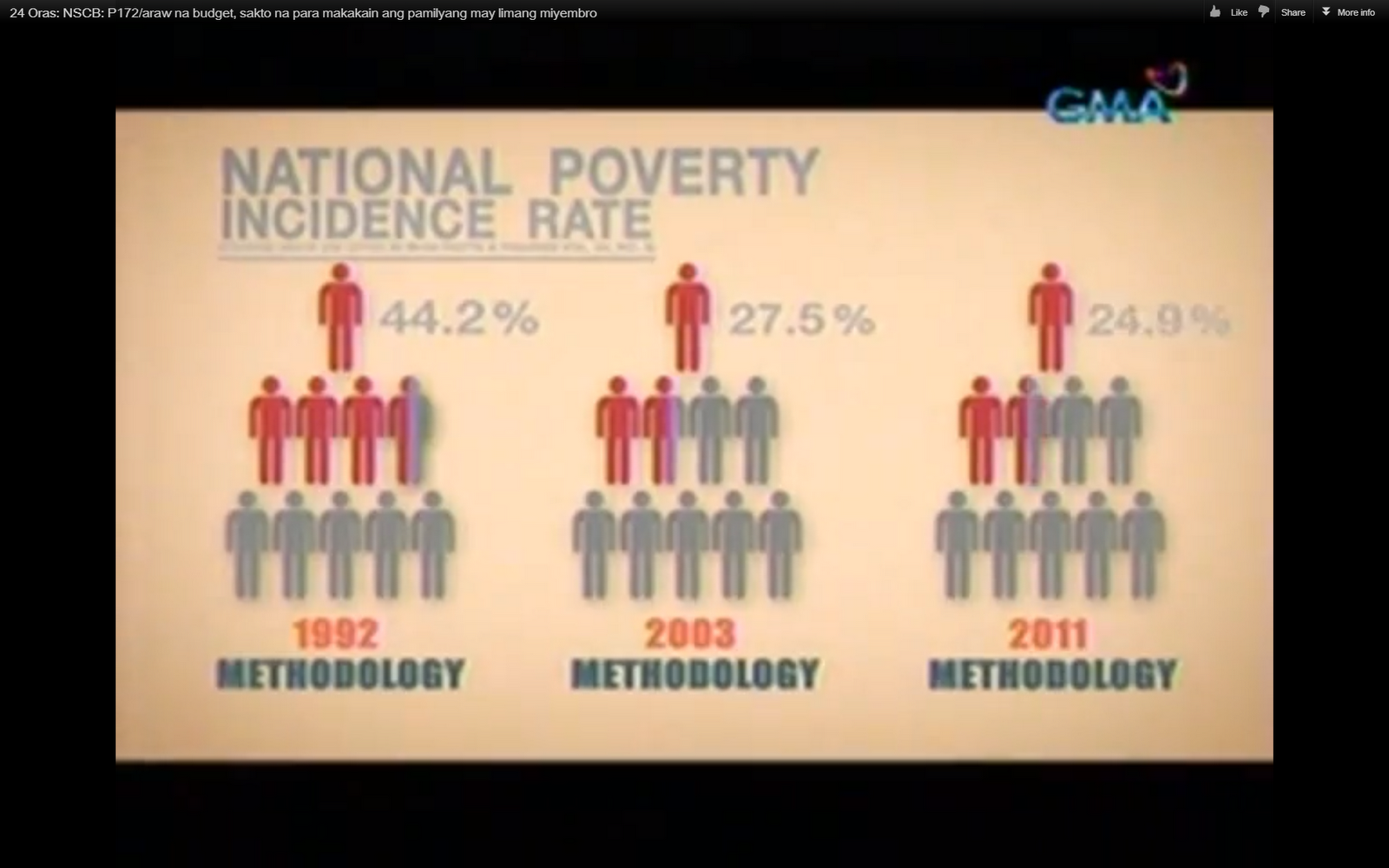
What's more shocking to me is, the government is actually using this food bundle price to measure the poverty rate.  "It was never our intention na pababain ang poverty incidence.  Siguro dapat lang ma-stress na ginawa lang tong refinement so that we can more accurately identify the poor.", Jessamyn Encarnacion, the Director of Social Statistics Office stated in a news interview with GMA.


Seriously?  They got away with it for almost ten years?


Really?  How low can oligarchs go?  There are so many dimensions to scale poverty and they only choose this?  Saddening.  Truly saddening.  Having worked at public hospitals during my time there as an occupational therapy intern, I met with the sad truth that poor people are getting poorer.   There even used to be a "free" classification for those who can't afford being treated at hospitals but now, there is none because of the millions of pesos cut from health.  On top of that, the government can boldly tell people not to worry as they suck their brains dry from the budget cut on education as well.  The government is raising a generation of people to be dumb enough not to question them with their corrupt ways.  And by being ignorant, we, in turn, are raising them as well!  


The news about food bundle for 2011

Apathy is what keeps us from reaching paraiso.  In twenty years, everything has changed and it had turned for the worse.  I don't mean to put the blame on anyone but in all sense, we make ourselves.  We did it to ourselves - the past generation and the present alike.  Keeping track and just watching isn't making a difference at all.  It just makes you part of the problem too.  And in all honesty,  for the past few months that I've been staying here in Canada, I am saddened by the mindset of those who have fled from the Philippines.  Not that I can blame them though, most of them had really tough lives when you hear them out.   But it's heartbreaking when you hear how they just plan to live off their lives peacefully here because the condition in the Philippines is really bad.  You always hear them talk about how bad it is there, how lucky that you're here and things like, "wala na tayo magagawa".  Coming from the mouth of a fellow Filipino tsk tsk tsk!    Yes, we are the lucky few who did get here!  Yes, we are the Filipinos who have more power than those back home!  Yes, we can do something!  


YES!!!

YES!!!

YES!!!

I'm sick and tired of people who say NO!  If we truly care about the land we were born in, we would look back.  And we will act now!  A later or an "I'll think about it" is a chance for things to turn for the worse.  And although poverty is far off from disappearing, together, we can start the change.  Together, we can make a difference.

Don't let the next decade sing "Paraiso" still.  


For the next generation, let us make a stand today.